Author Q&A: Michael Roque
Q&A with Michael Roque, author of WRITING TO A RAID SIREN.

Published by Atzei Rimon on 6 October 2026
Michael Roque is the author of Writing to a Raid Siren, a poetry collection written in the shadow of war, displacement, memory and emotional survival. Based in Tel Aviv since 2013, Roque writes about the psychological landscape of conflict alongside loneliness, love, identity and the strange persistence of ordinary life.
We spoke to Michael about finding his voice during wartime, the experiences behind the collection, his writing routine and what comes next.
When did you first start thinking of yourself as a writer?
Such a complex question. Doing. Saying. Feeling. Thinking. I started writing in 2009 and shortly after kind of declared writing as my thing. That said, I think I really started thinking of myself as a legit writer in 2021. I started feeling like a writer in 2024.
You grew up in Los Angeles and have lived in Tel Aviv since 2013. How has that move shaped your poetic voice and your sense of home?
For years, I went out of my way to preserve the poetic voice that came with the Los Angeles upbringing. The war breaking out and the heaviness of the whole period really was kind of the forced transition. It became unavoidable. The sirens, the hostage posters on the wall, the whole ever-extending psychological misery of 2024. How can I not write about this?
As for Israel shaping my sense of home, over the first few years, life bloomed here. First I met amazing friends, then my whole adult career took off, and a way of life kind of fused into my being. It became home because everything I care about is here.
“The war had a big psychological effect on me... The only time I didn’t feel awful was when I was writing. That’s one thing I have to be thankful for. I wrote a lot and stopped caring about rejection.”
What was the first poem that made you realise you were writing a collection, and what set it in motion?
I wish I could say it was one. In the middle of 2025, I had literally like 50 or 60 poems and was getting published by literary magazines quite often. Making a collection felt like the natural next step. The poem “Air Raid Sirens” is definitely kind of the star of the period. It was the poem that got the most attention. I felt like that had to be the leading poem.
The title is Writing to a Raid Siren, rather than writing “under” or “during” one. What does that word “to” mean to you?
I think “to” just rolled off the tongue easier than the rest. I remember walking on the beach in Yafo and just going through all the options, saying them out loud, and then after 10 or 15 minutes I had the version I wanted.
Which writers or books have had the greatest influence on you, and what have you learned from them?
My favorite book in my 20s was On the Road by Jack Kerouac. All of his books had a huge influence on me in my early and mid-20s. I went through a whole travel and experimental phase. I also loved John Fante. I think they really taught me how important it was to grasp life, live and take chances.
“I want the poems to convey the psychological damage of conflict... The sirens were a single awful facet of many. Literally leaving the apartment, breathing in the air, overhearing conversations were burdens.”
The collection moves between the public experience of war and private experiences of loneliness, longing and fractured relationships. Where do those worlds meet for you?
The war had a big psychological effect on me. I went through a depression and would get panic attacks. I didn’t even know it was that at the time. I thought I was sick or something. So I was going out a lot less, which is something I did a lot of before the war. I completely stopped going to the gym. I was frequently in a bad mood and snappy. My private life was a mess.
The only time I didn’t feel awful was when I was writing. That’s one thing I have to be thankful for. I wrote a lot and stopped caring about rejection, so I was sending poems out a lot and getting published a lot. Probably the only good thing about that period.
Were these poems written in the immediate aftermath of particular experiences, or did you need distance before you could find the words?
Before the war, I was writing from a very different place. God knows where from now. After things started, I didn’t write for four months. In February 2024, I wrote “Four Months into War.” That’s the immediate aftermath poem.
Then I went through a weird experimental phase. I really didn’t know where I was going with anything, but in September 2024, I found my new voice and then started going nuts.
What does your writing routine look like, and what helps you get started when the words aren’t coming?
I write maybe four nights a week. Usually late. I put on a playlist that goes with my mood and kind of let the music guide me. Sometimes it was Prince, other times it was something like XTC or the Doors.
“Before the war, I was writing from a very different place. I didn’t write for four months. Then I went through a weird experimental phase... I found my new voice and then started going nuts.”
Your imagery has been described as cinematic. When you begin a poem, what usually comes first: an image, a sound, a feeling or a line?
I definitely think of scenery, old ’80s and ’90s music videos, and try to create worlds that I can bring someone into.
Tenderness runs through the book alongside fear and instability. Can you tell us about a moment of tenderness that found its way into a poem?
Even when the world is running down, you’re still living life. Going out with friends, falling in love and also finding tenderness in the past. I never did so much reminiscing about better days as I did during those horrible times. You remember people you once loved and lost in the years that had passed.
Faith and identity are among the collection’s themes. What questions about them emerged as you wrote, and did any of the poems surprise you with an answer?
I think the war killed me for a year. For a year, I felt everything I believed in, the values and views I had held for years, were all suddenly irrelevant. Then I kind of just followed the narrative everyone around me was spinning in the hurt and fear.
“Buried Alive in a Designer Coffin” is a poem I wrote about snapping out of the war mindset and finding my old self. The identity that was buried outside of the comforts of conformity. This poem was me realizing that I was never meant to be the person the war transformed me into.
“Israel's way of life kind of fused into my being. It became home because everything I care about is here.”
What’s a piece of writing advice you’ve found useful, and one you’ve learned to ignore?
One piece of advice is that every word must hit, must bloom. Nothing should be just there. Everything matters. The suspense needs to be kept up. I’ve ignored so much advice throughout the years that I wouldn’t even know where to begin.
How did you decide which poem should open the collection and which should close it? What journey did you want that sequence to create?
I think “Air Raid Sirens” puts someone in the thick of it. I think it’s a sharp and great opener. The second poem really is the symbolic start, but I felt it wasn’t as good as an actual starting poem. “Four Months into War” is literally the first poem I wrote after a four-month hiatus from writing after the war started.
The last poem isn’t much of a closer because nothing closed in life. When I finished writing this collection in 2025, everything was still up in the air over here and, quite honestly, I still feel like it’s up there.
“Every word must hit, must bloom. Nothing should be just there. Everything matters.”
For someone who has never heard an air raid siren, what do you hope these poems convey about the life that continues around that sound?
I want the poems to convey the psychological damage of conflict. When it comes to the sirens and the rockets themselves, I don’t think I was ever in real grave danger. I’ve always been aware of the odds of actually getting hit and how low they are, especially considering the Iron Dome and the sheer size of Tel Aviv.
The sirens were a single awful facet of many. Literally leaving the apartment, breathing in the air, overhearing conversations were burdens.
What are you interested in exploring in your next writing project?
I already have a next project nearly done. A small collection with a working title of My Life in 17 Cities. It’s 17 poems about 17 cities I’ve lived in or visited, and my experience there serves as a metaphor for my current life and feelings.
I was in Cairo’s Arab Spring in 2011. The first and only revolution I ever experienced first-hand. I have a poem about that, but it’s more about the revolution of self. The constant battle between a me that’s a self-suppressor and a me that wants to be liberated.
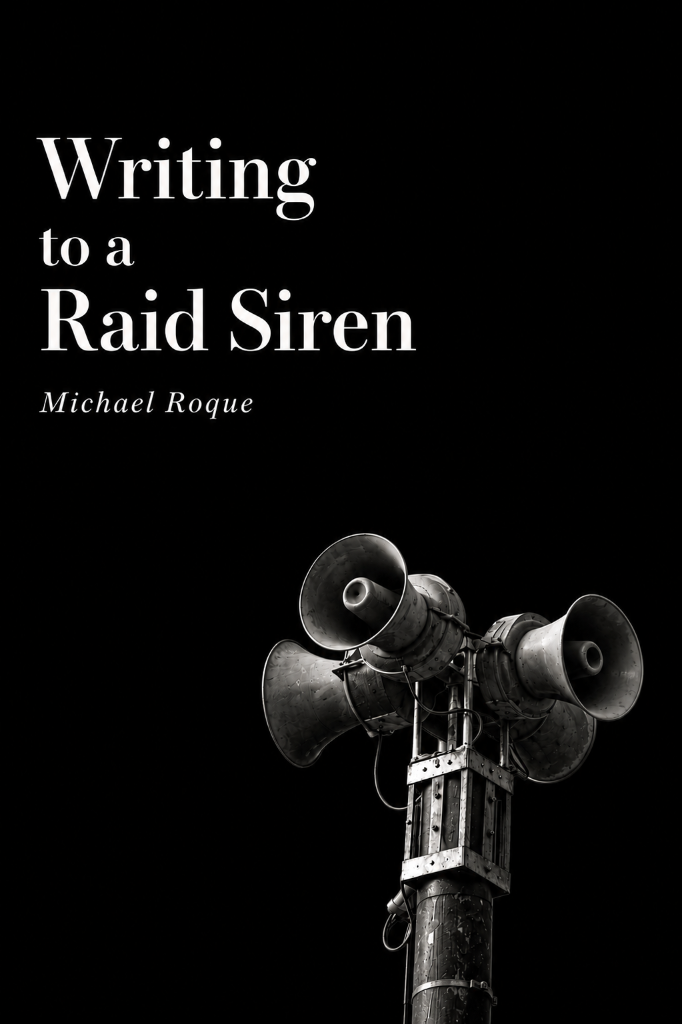
Writing to a Raid Siren is available now from the Pomegranate Press website and all good bookshops. Buy now